Why a Chef Led Sushi Restaurant Matters
Updated: May 6
You can see the difference before the first piece is served. In a chef led sushi restaurant, the room feels more composed, the menu feels more deliberate, and each course appears to have a reason for being there. Nothing is crowded onto the plate for effect. Nothing is included merely because it sells. The experience is shaped by judgement.
That distinction matters more than many diners realise. Sushi is often discussed in terms of freshness, grade and presentation, but the real measure of quality is authorship. Who is deciding what to serve, how to cut it, how to season it, when to age it, and what to leave out? In serious Japanese dining, those choices define the meal.
What sets a chef led sushi restaurant apart
A chef led sushi restaurant is built around a point of view. That does not mean theatrical dining or unnecessary ceremony. It means the restaurant reflects the discipline, standards and palate of the chef at its centre. The menu is not assembled by trend, supplier convenience or broad-market compromise. It is curated.
For guests, that creates a very different form of trust. You are not simply ordering sushi. You are placing confidence in a chef's ability to interpret seasonality, balance texture, and present each ingredient with restraint. The value lies not only in premium fish, but in the intelligence behind it.
This is particularly important with sushi because simplicity can be misleading. A piece of nigiri may look minimal, yet every detail matters - rice temperature, grain definition, knife angle, curing time, soy balance, wasabi placement. There is nowhere to hide. In a chef-led setting, technical standards are not a back-of-house aspiration. They are the whole structure.
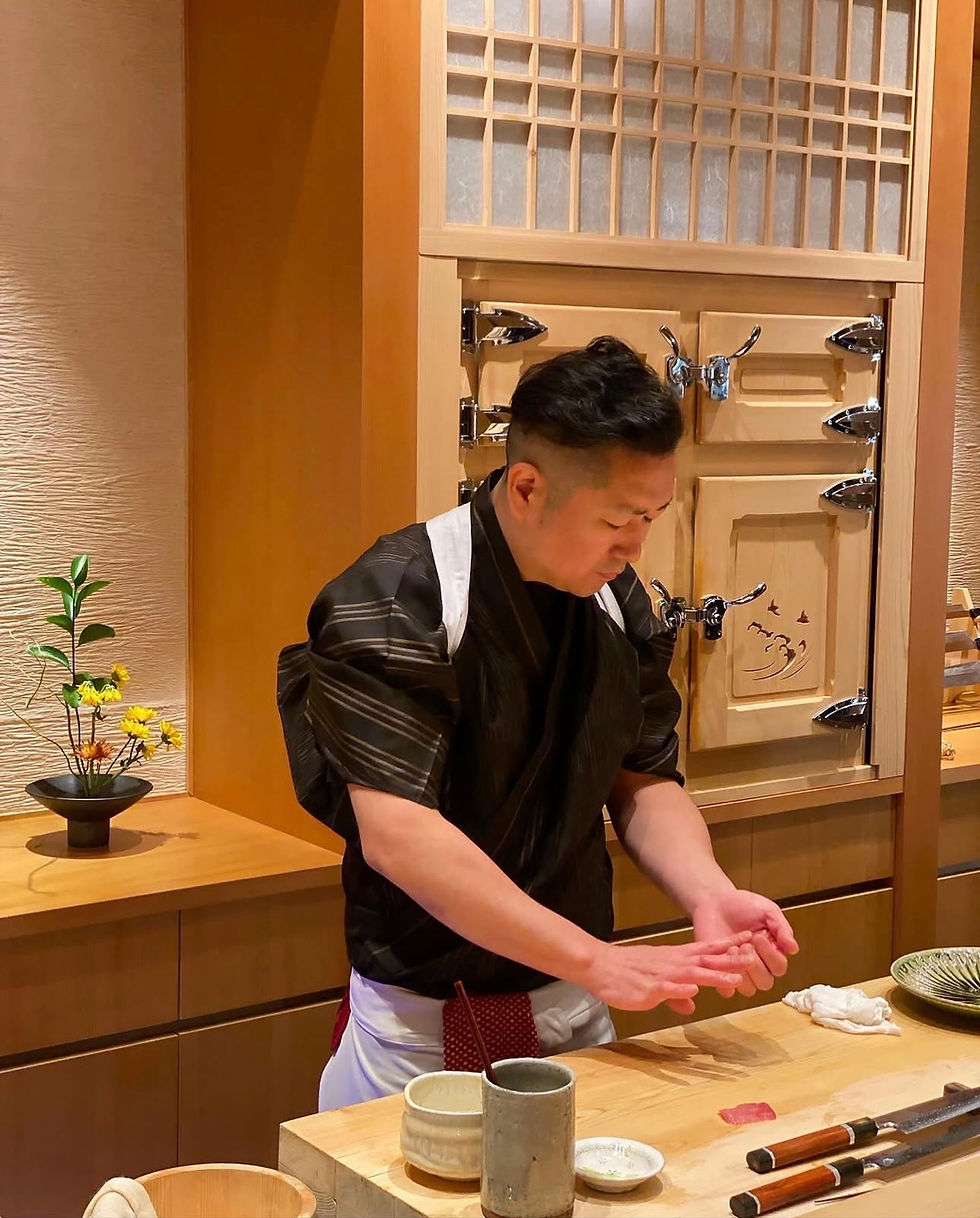
The chef's hand is present in every course
When a restaurant is truly led by a chef, quality becomes more consistent because the standard is personal. A chef with a clear philosophy will shape sourcing, prep, seasoning and service rhythm in ways that guests can feel, even if they cannot name each choice.
Take rice, for example. It is easy to talk about tuna, uni or scallop because those ingredients sound luxurious. Yet sushi rice reveals the seriousness of the kitchen more clearly than any premium topping. The seasoning must support the fish rather than overpower it. The texture must hold without turning dense. The warmth must be judged carefully. In a generic operation, rice is often treated as a base. In a chef-led room, it is treated as the foundation.
The same applies to progression. A thoughtful chef does not merely offer an assortment. The meal moves with intention. Richer cuts are balanced by cleaner ones. Marinated items are offset by fresher expressions. Texture shifts keep the palate alert. This sense of composition separates a memorable dinner from an expensive one.
Why chef-led dining feels more personal
Refinement is not always about formality. Often, it is about attention. A chef led sushi restaurant tends to feel more personal because someone is actively shaping the guest experience rather than simply managing throughput.
That can show itself in subtle ways. A first-time guest may be guided towards a balanced selection rather than the loudest ingredients on the menu. A business dinner may require a certain pace and privacy. A celebratory meal may call for something more immersive. When the restaurant is centred on craft, hospitality becomes more precise.
This is where chef credibility matters. Diners who seek premium Japanese cuisine are usually not looking for excess. They are looking for discernment. They want to know that the quality on the plate reflects years of training, not branding language. A chef's name attached to a restaurant carries weight because it suggests accountability. Standards are no longer abstract. They belong to someone.
The trade-off: focus over variety
There is, of course, a trade-off. A chef led sushi restaurant is rarely designed to please every possible preference. The menu may be narrower. The style may be more exacting. Certain adaptations that are common in broader sushi outlets may not sit naturally within the kitchen's philosophy.
For the right guest, that is a strength rather than a limitation. Focus usually produces better cooking. A restaurant that knows what it is can deliver a more coherent experience than one trying to satisfy every passing taste. Still, it depends on the occasion. If the priority is pure convenience or a highly customised casual meal, a chef-led format may feel more structured than necessary.
That is not a flaw. It simply reflects a different purpose. The best chef-led restaurants are not trying to be all things at once. They are trying to do a smaller number of things exceptionally well.
Chef led sushi restaurant expectations and reality
The phrase chef led sushi restaurant can sometimes be used too loosely. A chef's name on the sign does not automatically guarantee quality. For diners, the better question is whether the chef's standards are visible in the actual experience.
You can usually tell quite quickly. Is the menu edited with confidence, or padded with familiar filler? Does the fish taste as though it has been handled with precision? Is the balance of the rice considered? Does the service feel informed rather than scripted? These details reveal whether the chef is genuinely present in the restaurant's identity.
The room matters too. Premium Japanese dining should feel calm, not cold. Polished, not performative. Serious food does not require stiffness. In fact, the strongest hospitality often feels effortless because so much judgement has already been applied behind the scenes.
Why this matters for modern diners
Today’s premium diner often wants two things at once: authenticity and convenience. Those desires are not in conflict, but they do require discipline from the restaurant. It is one thing to offer elevated sushi in the dining room. It is another to maintain standards across reservations, private dining and takeaway without diluting the brand.
A strong chef-led model makes that possible because the standard is clearly defined from the start. If the chef's philosophy governs ingredient quality, preparation and presentation, the guest can expect a degree of continuity across formats. A private dinner should still feel composed. A takeaway order should still reflect care. Convenience only adds value when quality survives the journey.
This is one reason chef-led restaurants continue to attract discerning urban diners. They offer more than a meal. They offer confidence. For professionals hosting clients, couples choosing a meaningful dinner, or small groups seeking a polished setting, that confidence matters. The evening does not need to prove itself through noise. It simply needs to be right.
At Sushi Ayumu by Masa Ishibashi, that principle is easy to understand. The chef-led identity does more than frame the brand. It signals that the experience has an author.
How to recognise a restaurant worth returning to
The best sushi meals often stay with you for quiet reasons. A piece of fish tasted cleaner than expected. The seasoning was exact. The pacing felt natural. You left satisfied rather than overwhelmed. Those impressions are rarely accidental.
A restaurant worth returning to tends to have a clear internal standard. It does not chase novelty for its own sake. It does not confuse luxury with abundance. Instead, it refines. Over time, that refinement becomes recognisable. Guests return because they trust the judgement behind the food.
That trust is especially valuable in sushi, where quality depends on many choices the guest never sees. Storage, ageing, butchery, temperature, rice preparation and timing all affect the result. The chef's role is to absorb that complexity and present something that feels simple on the plate. When done properly, the meal carries a sense of ease that has been earned through discipline.
For diners who value authenticity, craft and a more considered form of hospitality, a chef-led sushi restaurant offers something increasingly rare: a clear point of view, expressed with restraint. And once you have experienced sushi shaped by that level of intention, it becomes much harder to settle for less.



Comments