Japanese Fine Dining Review: What Matters
A Japanese fine dining review can go wrong in the first five minutes. Too often, it begins and ends with price, theatre, and whether the fish looked pristine under soft lighting. That misses the point. Fine Japanese dining is not built on display alone. It is built on judgement - of temperature, timing, restraint, knife work, rice, pacing, and the quiet confidence to leave something untouched when excess would only weaken the dish.
For guests who choose this style of restaurant deliberately, the better question is not whether dinner felt luxurious. It is whether every element showed intention. In Japanese cuisine, refinement is rarely loud. The strongest meals often feel effortless, even though they are anything but.
How to read a Japanese fine dining review properly
A serious review should pay attention to what the restaurant is trying to achieve. Not every high-end Japanese restaurant is pursuing the same ideal. One may centre an omakase progression led by seasonality and dialogue with the chef. Another may favour a broader formal menu with sushi, cooked dishes, and a stronger hospitality focus for business dining or celebrations. Both can be excellent, but they should not be judged as if they are identical formats.
That is why a useful review looks at coherence rather than spectacle. Does the meal have a clear point of view? Do the dishes relate to one another? Is the service aligned with the tone of the room? A polished restaurant should feel composed from the first greeting to the last course. If a meal offers impressive ingredients but no sense of rhythm, it may still be expensive, but it is not necessarily fine dining at its best.
Ingredient quality is only the beginning
Premium bluefin tuna, black abalone, Hokkaido uni, caviar, and truffle can impress at first glance. They do not guarantee quality on the plate. In Japanese fine dining, ingredient quality matters enormously, but what matters just as much is how the kitchen handles those ingredients.
Fish should be served at a temperature that allows flavour and texture to open fully. Rice should never feel like an afterthought beneath the topping. Wasabi should support the piece rather than dominate it. Soyu should be used with precision, if at all. When cooked dishes appear, whether chawanmushi, grilled fish, broth-based courses, the test is the same. Is the seasoning exact? Is the texture deliberate? Does each element belong?
The finest restaurants show discipline here. They do not stack luxury on luxury for effect. They know when simplicity carries greater authority.
The overlooked core of any Japanese fine dining review
If the restaurant serves sushi, the rice deserves as much attention as the fish. This is where many reviews become superficial. Guests may describe a beautiful cut of otoro in detail and say almost nothing about the shari, even though the rice often reveals the standard of the house more clearly than any premium topping can.
Excellent sushi rice has structure without heaviness. It should hold together, then loosen cleanly. Its seasoning should be present but measured, balancing sweetness, salt, and acidity without turning sharp. Temperature matters greatly. Rice that is too cold feels lifeless; too warm, and it begins to distort the fish. When the rice is right, each piece tastes integrated rather than assembled.
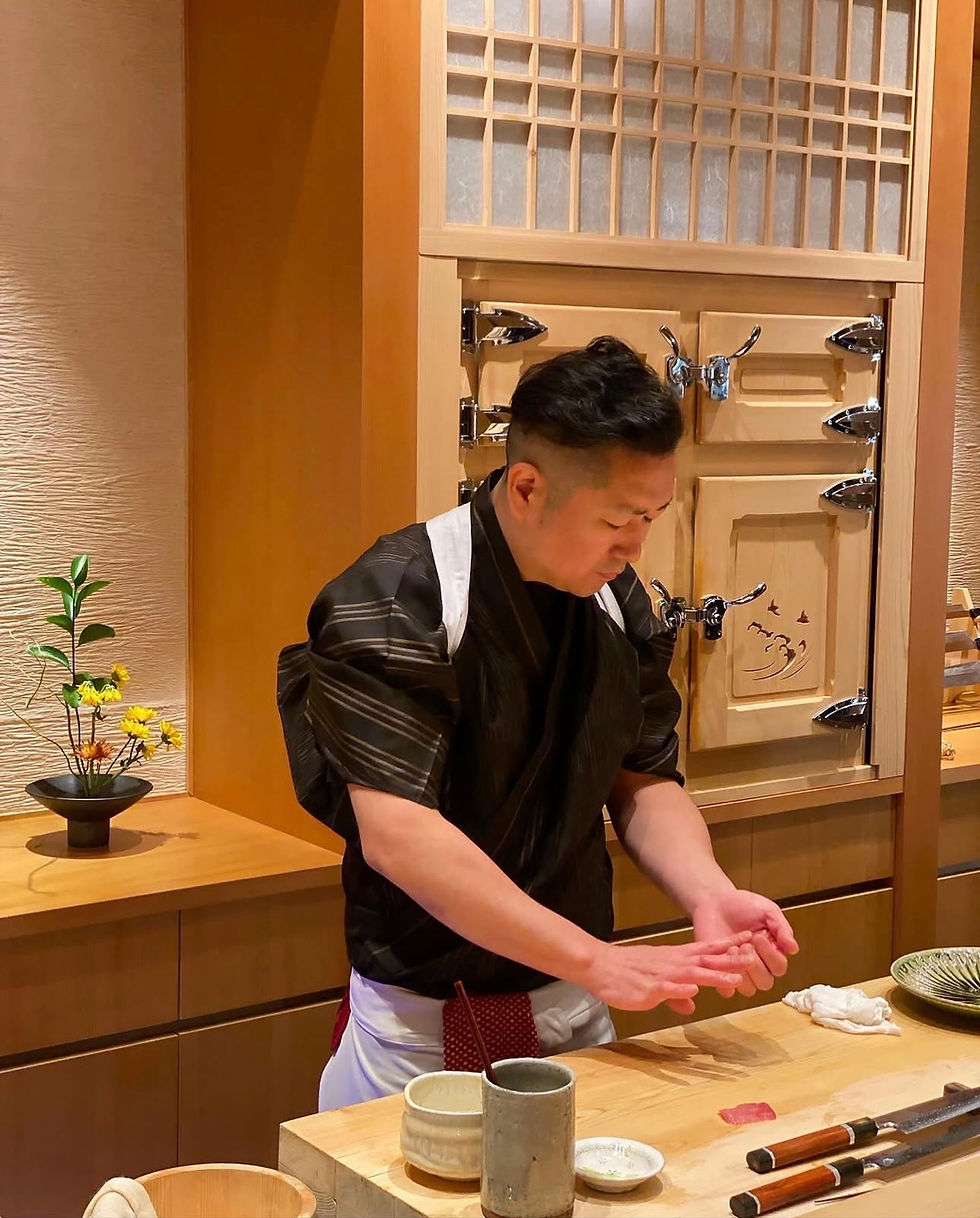
This is also where craftsmanship becomes unmistakable. Knife work, pressure in shaping, and proportion all affect the final bite. A restaurant can have access to strong suppliers and still fall short if the technique lacks control. Conversely, a chef with exacting standards can make a modest-looking piece feel memorable because every variable has been considered.
Service should be informed, never overbearing
In fine Japanese dining, service is part of the cuisine. It frames the guest experience without pulling focus from it. The best rooms understand how to be attentive without intrusion. Water is replenished before it needs to be requested. Courses arrive with calm assurance. Explanations are clear, brief, and relevant.
What does not work is performance for its own sake. A long speech for every course can interrupt the meal. Equally, a lack of guidance can leave guests uncertain, particularly when the menu includes seasonal specials or chef-led selections. The strongest service teams read the table well. A business dinner may need discretion and pace. A celebratory meal may welcome more interaction. A couple at the counter may value greater detail and a sense of exchange.
This flexibility is one of the clearest marks of a mature restaurant. Fine dining should feel considered, not rigid.
Atmosphere matters, but not in the obvious way
Many high-end dining rooms understand lighting, materials, and counter spacing. Those things matter, but atmosphere is shaped just as much by what the room allows guests to feel. Is it calm? Is it controlled? Can conversation happen comfortably? Does the setting support attention to the food?
Japanese fine dining often works best when the design is restrained. Natural materials, clean lines, and quiet confidence suit the cuisine because they leave space for nuance. A dining room that tries too hard to signal luxury can become distracting. By contrast, a room with genuine composure feels immediate and lasting.
This is especially relevant for private dining. Guests booking a private room for a celebration or client dinner are not only buying exclusivity. They are choosing privacy, pace, and the ability to experience the meal without interruption. In that context, the room itself becomes part of the service proposition.

Authenticity is more than appearance
Authenticity is one of the most overused words in restaurant writing. In a Japanese fine dining review, it should mean more than imported ingredients, Japanese tableware, or a minimalist interior. Real authenticity comes from fidelity to the principles behind the food.
That may show itself in seasonality, in respect for ingredient integrity, in measured seasoning, or in the refusal to overcomplicate a dish that is already complete. It can also appear in hospitality - in the courtesy, precision, and humility with which a meal is presented. None of this requires stiffness. It requires standards.
At the same time, authenticity does not have to mean strict traditionalism. A chef-led restaurant such as Sushi Ayumu by Masa Ishibashi earns credibility when modern convenience sits alongside a genuinely disciplined dining experience.
Price, value, and expectations
A useful Japanese fine dining review should address value without reducing the meal to cost per course. Premium Japanese dining is expensive for obvious reasons: specialist sourcing, high skill, low-margin perishables, and service standards all shape the price. But guests are still right to ask whether the experience justified it.
Value lies in alignment. If the restaurant promises precision, rarity, and a curated experience, the meal should deliver all three. If the room positions itself as refined but the pacing is erratic or the sushi inconsistent, the gap becomes difficult to ignore. Equally, a restaurant may offer a focused, beautifully judged meal with less overt extravagance and provide better value than a more flamboyant competitor.
This is where expectations matter. A diner seeking a hushed omakase counter may be disappointed by a larger, more socially energetic dining room, even if the food is strong. Another guest may prefer that energy, especially for group dining. The fairest review recognises these differences and judges the restaurant on the promise it actually makes.
What separates a memorable meal from a merely expensive one
The distinction usually comes down to consistency of judgement. A memorable meal does not rely on a single signature bite to carry the evening. It maintains quality across every stage - the greeting, the first pour of tea, the opening appetiser, the sushi sequence, the cooked courses, dessert, and the final farewell.
There should be no dead space in the experience. Not every course has to astonish, but none should feel careless. That level of control is rare. It is also why the best Japanese fine dining lingers in the memory. Guests remember not only what they ate, but how fully the meal held its standard from start to finish.
When reading or writing a Japanese fine dining review, it is worth looking past the obvious signals of luxury. The true measure is quieter than that. It sits in the rice, the timing, the service, and the confidence to do less, better. For diners who care about craft, that is where the real value begins.



Comments